What are the Differences Between Bonds and Stocks?
- 8th April 2026
- 04:45 PM
- 6 min read






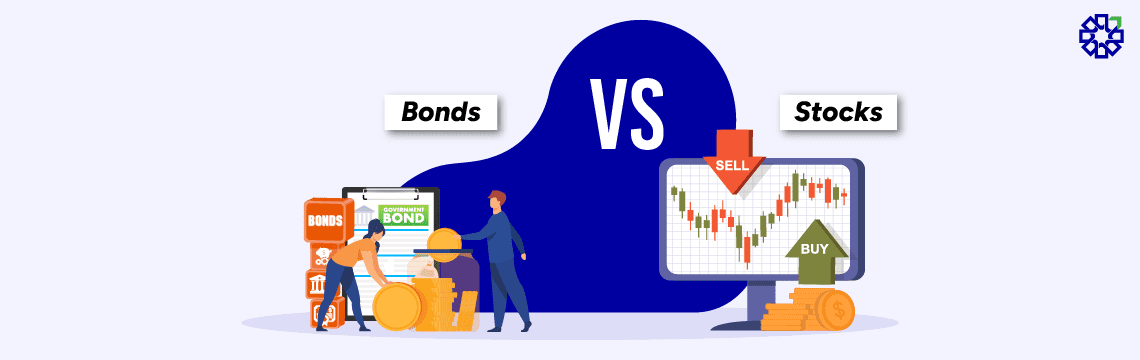
Bonds and stocks are two crucial investment options which help you diversify your investment portfolio and earn higher returns. While bonds offer stability, stocks focus on growth potential.
It becomes difficult for investors to choose between them, but they forget that both of these instruments offer different types of features. Choosing between stocks and bonds depends on your investment goal and risk tolerance.
Let us understand the key difference between bonds and stocks across several parameters.
What are Bonds and Stocks?
Bonds are debt instruments which appear in the liabilities of a company’s balance sheet. Bonds help you to raise funds by providing fixed returns as interest. Any organisation can issue bonds, including the government, corporations, and non-profit organisations. Moreover, bonds are traded on the stock exchanges, and their transactional volume is lower than that of stocks.
Stocks represent ownership of a company, and they are considered to be liquid compared to fixed-income instruments. When a company wants to raise money, it issues shares and invites investors to buy them. In return, the investors get a percentage of ownership in the company, the right to vote and earn excess gains.
The key difference between bonds and stocks is that bonds offer you a fixed repayment as interest, while stocks offer you returns through capital appreciation.
Key Features of Bonds
-
Call Option
Bonds help the issuing company to repurchase its bonds at a price more than their par value.
-
Principal Repayment
While investing in bonds, the principal is returned to you on a fixed date. The maturity or repayment date is the time mentioned in the bond.
-
Covenants
Covenants are agreements between a company and investors through trustees.
-
Interest Payouts
The interest rate is the coupon rate at which the interest amount is paid on regular intervals by the authority that has issued the bond.
Key Features of Stocks
-
High Return
You can invest in shares for capital appreciation whose price keeps rising. You can generate income as a bonus and dividends.
-
Ownership Rights
A share is a unit of ownership of the company, which also offers voting rights for stockholders.
-
Risk Factors
Stocks have a significant level of risk, and you should consider your risk appetite before investing in them. In addition, you can diversify your portfolio to diversify the risk.
What are the Types of Bonds and Stocks?
-
Types of Bonds
| Types | Issuer |
| Government bonds | National Government |
| Municipal bonds | States or Cities |
| Corporate bonds | Companies |
| Convertible bonds | High-growth companies |
| Zero-coupon bonds | The government |
-
Types of Stocks
| Types | Meaning |
| Common stock | Offer voting rights |
| Preferred stock | Offer fixed dividends, no voting rights |
| Value stock | Priced lower than the company’s intrinsic value |
| Income stock | Provides regular dividends |
| Growth stock | Companies reinvest profits for expansion |
| Penny stock | Lower-priced stocks with high risk |
| Blue-chip stock | Stocks of large, stable, and popular companies |
You can access a wide variety of stocks and bonds while using the PL Capital Group – Prabhudas Lilladher application. PL Capital also allows you to open a Demat account for free.
Bonds vs Stocks: Key Differences
| Parameters | Bonds | Stocks |
| Security type | Debt | Equity |
| Issuer | Public sector undertakings, companies, credit institutions, and supranational institutions | Corporations and joint-stock companies |
| Benefits | Investors get priority during repayment and liquidation | Investors gain voting rights |
| Taxation | Not liable for tax | May have to pay the dividend distribution tax on returns |
| Participants | The major participants are the investors, institutional investors and speculators. | The main participants are market makers, traders and brokers. |
| Market | They are traded over the counter (OTC), and the bond market does not have a centralised exchange system. | You can trade shares through stock exchanges, and the market has a centralised trading or exchange system. |
Bonds vs Stocks: Risk and Returns
The difference between bonds and stocks, based on risk and returns, is that in bonds, you can earn a fixed repayment as interest. Additionally, they are less risky since they are rated by the credit rating agencies, and mostly yield a fixed income.
On the other hand, you can earn returns while investing in stocks due to capital appreciation if the stock prices increase and you receive dividends. However, dividends are not guaranteed, since stocks are highly dependent on the issuer’s performance. In addition, the risk level of stocks is relatively high as investors do not earn fixed returns.
Final Thoughts
You need to understand the difference between bonds and stocks to make informed decisions while investing. Stocks help you earn dividends and take advantage of capital appreciation if the stock prices increase. Investing in bonds allows you to earn a fixed repayment as interest.
However, you should also consider the risk factors while choosing between bonds vs stocks. Download the PL Capital application and invest in stocks and bonds of your choice.
Frequently Asked Questions
1. What distinguishes bonds from stocks?
Stocks provide you with partial ownership in a company and offer high growth opportunities and dividends, while bonds are loans to governments and companies, which provide you with fixed interest payments and principal repayment.
2. Which is riskier, bonds or stocks?
Stocks are typically riskier than bonds because of higher volatility and have potential for significant price fluctuations due to market sentiment.
3. Can investors lose money in bonds?
Yes, investors can make losses while investing in bonds because of numerous factors, although they are often considered safer than stocks.
4. Can I invest in both bonds and stocks?
Yes, you can invest in both bonds and stocks, which is also helpful for creating a balanced and diversified portfolio.