
Equity Mutual Funds
Explore top Equity fund categories
Equity mutual funds invest primarily in company stocks, offering investors the potential for long-term capital growth through participation in equity markets. Whether you are a first-time investor building your financial foundation or a seasoned investor seeking higher returns, equity mutual funds offer a professionally managed, diversified route into the equity market. With PL Capital, backed by over 80 years of market experience since 1944, you can explore and invest in equity mutual funds with clarity, confidence, and conviction.
Invest in Equity Mutual Funds
Fund Categories
Overview of Equity Mutual Funds
Equity mutual funds pool money from multiple investors and invest the corpus predominantly in equity shares of companies across market capitalisations, large cap, mid cap, and small cap. These funds are managed by experienced fund managers who conduct rigorous research to select stocks aligned with the fund’s investment objective, be it growth, value, dividend yield, or a sectoral/thematic focus.
The performance of equity funds is directly linked to stock market movements. While this introduces a degree of volatility, the equity asset class has historically delivered superior returns over long investment horizons of five years and above. Equity mutual funds are regulated by the Securities and Exchange Board of India (SEBI) and are offered by SEBI-registered Asset Management Companies (AMCs).
On PL Capital’s platform, investors can access a curated selection of equity mutual funds spanning diversified equity, sectoral, thematic, ELSS, and index categories. The platform provides comprehensive fund analytics, historical performance data, and personalized recommendations to help you make informed, data driven investment decisions.
Risks Involved in Equity Mutual Funds
Like all market linked instruments, equity mutual funds carry inherent risks that investors should be aware of before committing capital.
Market risk is the primary concern fund NAVs fluctuate daily with equity market movements, and short term volatility can erode interim portfolio value. Concentration risk applies to sectoral or thematic funds, where a focused portfolio amplifies the impact of sector specific downturns. Liquidity risk, though limited in open ended funds, may arise in small cap or mid cap focused strategies during periods of market stress.
Currency risk is relevant for international equity funds that invest in foreign markets. Additionally, fund manager risk where changes in fund management may alter investment style and performance should be factored into selection. Investors are encouraged to align their risk appetite with the fund’s risk profile before investing. Mutual fund investments are subject to market risks.
Please read all scheme related documents carefully.
Factors To Consider Before Investing in Equity Mutual Funds
Making the right equity mutual fund selection requires evaluating several key parameters.
Your investment objective should be the starting point, equity funds are best suited for long term wealth creation goals rather than short term income needs. Assess your risk tolerance honestly, as equity portfolios can experience significant NAV swings in volatile markets. The investment horizon matters critically: equity funds tend to reward patience, with meaningful alpha typically visible over a 5 -10 year period.
Evaluate the fund’s historical performance relative to its benchmark and category peers across multiple market cycles. The expense ratio directly impacts net returns, lower costs compound meaningfully over time. The fund manager’s experience, investment philosophy, and track record should be reviewed carefully. Finally, consider the fund’s portfolio concentration, turnover ratio, and alignment with your existing asset allocation.
List of Top Equity Mutual Funds
The following table provides a reference framework for evaluating top performing equity mutual fund categories available on the PL Capital platform. Performance data is indicative and subject to market movements.
| Fund Category | Risk Level | Ideal Horizon | Benchmark |
| Large Cap Equity Funds | Moderate | 5+ years | Nifty 100 / BSE 100 |
| Mid Cap Equity Funds | Moderately High | 7+ years | Nifty Midcap 150 |
| Small Cap Equity Funds | High | 7–10 years | Nifty Smallcap 250 |
| ELSS (Tax Saving) Funds | Moderate–High | 3+ years (lock-in) | Nifty 500 |
| Flexi Cap Funds | Moderate–High | 5+ years | Nifty 500 |
| Sectoral / Thematic Funds | High | 5–7+ years | Sector specific index |
How Do Equity Mutual Funds Work?
Understanding the mechanics of equity mutual funds helps investors make more confident decisions.
When you invest in an equity mutual fund, your capital is pooled with that of other investors to form a collective corpus. The AMC’s fund manager deploys this corpus by purchasing equity shares of companies selected through fundamental and quantitative research. Each investor receives units of the fund proportional to their investment, at the prevailing Net Asset Value (NAV).
The NAV of an equity fund is calculated daily by dividing the total market value of the fund’s equity holdings (net of liabilities) by the number of outstanding units. As the underlying stock prices rise or fall, the NAV adjusts accordingly.
Open ended equity funds allow investors to buy or redeem units on any business day at the prevailing NAV. Closed ended equity funds, such as fixed term plans, allow investment only during the New Fund Offer (NFO) period and are listed on stock exchanges thereafter.
Equity mutual funds generate returns through two primary channels: capital appreciation (rise in NAV as stock prices increase) and dividend distributions from underlying portfolio holdings. Over long investment horizons, the compounding effect of reinvested returns can create significant wealth for disciplined investors.
Advantages of Equity Mutual Funds
- Professional fund managers handle stock selection, portfolio construction, and rebalancing on your behalf.
- A single fund investment gives you exposure to a portfolio of 40 to 100 stocks, spreading individual company risk across a broad base.
- You can start a SIP with as little as Rs 500 per month, making systematic wealth creation accessible at every income level.
- Open-ended equity funds allow you to redeem your investment on any business day.
- SEBI oversight ensures transparency in portfolio disclosures, expense ratios, and fund operations.
- ELSS funds offer Section 80C tax deductions of up to Rs 1.5 lakh per annum while providing equity market exposure.
- PL Capital’s platform gives you real-time portfolio tracking, monthly performance reports, and access to over 40 fund partners across all equity sub-categories.
How to Invest in Equity Mutual Funds?
Step 1: Download the app
Download the PL Capital app from the Play Store and open an account.
Step 2: Complete risk profiling
Answer a short questionnaire to assess your risk comfort and investment goals.
Step 3: Explore equity mutual funds
Browse and filter funds by category, risk level, fund house, and past performance.
Step 4: Review fund details
Check the factsheet, performance history, expense ratio, and fund manager track record.
Step 6: Choose your investment mode
Select lump sum for a one-time investment or SIP to invest a fixed amount regularly.
Step 7: Confirm your investment
Review the amount and investment mode, then submit your order. Units are allotted at the applicable NAV.
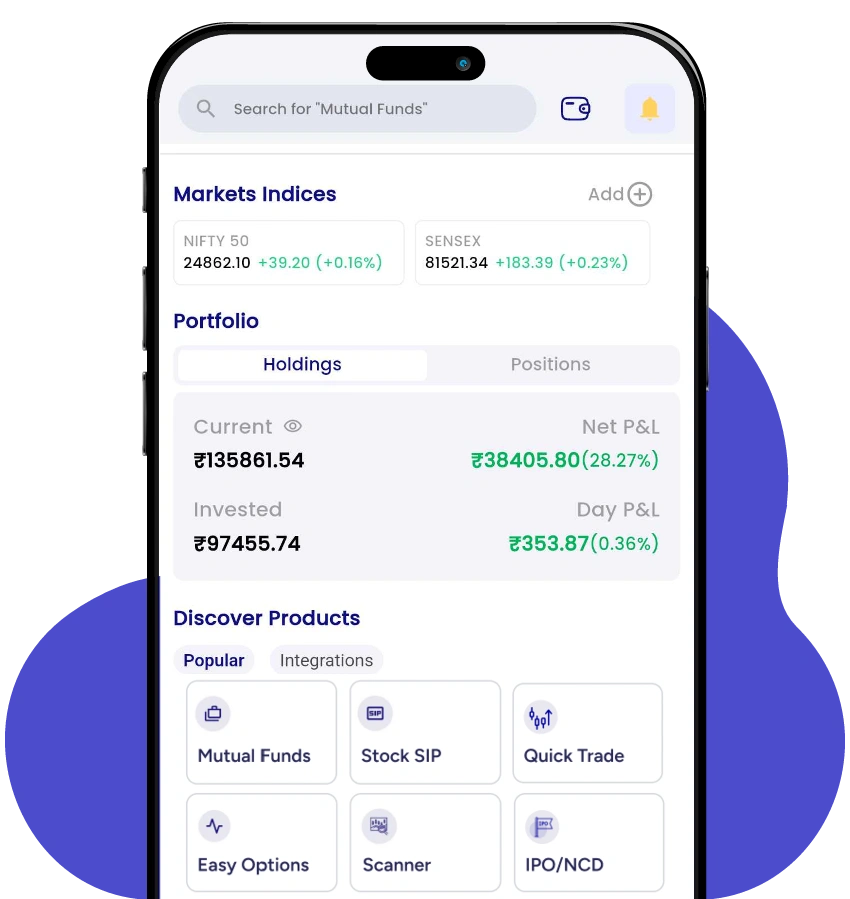
Now you can monitor your Mutual Funds — NAV updates, returns, and reports directly in the PL Capital app.
Why Should You Invest in Equity Mutual Funds?
Equity mutual funds have historically been one of the most effective vehicles for long-term wealth creation in India. Here is why they deserve a place in your portfolio:
Long term wealth creation: The Indian equity market has delivered strong returns over extended horizons, and professionally managed equity funds have the potential to amplify this growth through active stock selection.
Beat inflation: Equity mutual fund returns have historically outpaced inflation over the long term, preserving and growing the real value of your investment.
Flexibility of investment: Invest through SIP with as little as INR 500 per month or through lump sum. Equity mutual funds accommodate different financial situations.
Tax efficiency: ELSS funds offer dual benefits of tax savings under Section 80C and equity market participation with only a three year lock-in period.
Expert guidance on PL Capital: Access personalised advice from experienced financial advisors backed by PL Capital’s eight decades of market knowledge.
Wide choice of funds: Over 40 AMC partners on the PL Capital platform offer a comprehensive range of equity fund categories to match every investment objective.
Taxation Rules of Equity Mutual Funds
Understanding the tax implications of equity mutual fund investments is essential for accurate financial planning.
For equity funds (those with equity exposure of 65% or more), short term capital gains (STCG) apply when units are redeemed within 12 months of purchase. As per current tax regulations (effective from Budget 2024), STCG is taxed at 20%. Long term capital gains (LTCG) arise on redemption after 12 months. Gains up to INR 1.25 lakh per financial year are exempt from tax; gains above this threshold are taxed at 12.5% without the benefit of indexation.
Dividend income from equity mutual funds is added to the investor’s total income and taxed at the applicable income tax slab rate. For ELSS funds specifically, the three year lock in period qualifies the investment for a Section 80C deduction of up to INR 1.5 lakh, providing direct tax savings in the year of investment. Investors are advised to consult a qualified tax advisor for personalised guidance. Data validated as of 07/04/2026.
Conclusion
Equity mutual funds remain one of the most compelling long term investment options for investors seeking to build wealth systematically. With the backing of professional fund management, built in diversification, and the discipline of SIP based investing, they offer a structured path to financial goals whether that is a child’s education, retirement, or capital appreciation over a decade.
PL Capital, with its legacy of over 80 years and access to 40+ AMC partners, provides the platform, expertise, and tools to help you invest in equity mutual funds with clarity and confidence. Start your SIP today or explore our full range of equity fund options on plindia.com.
FAQs on Equity Mutual Funds
What is Equity Mutual Funds?
Equity mutual funds are professionally managed investment vehicles that pool money from multiple investors and invest the corpus predominantly in equity shares of companies. The goal is long term capital appreciation by participating in the growth of listed companies. They are regulated by SEBI and offered through registered AMCs. Different sub-categories like large cap, mid cap, small cap, ELSS, flexi cap they cater to varying risk profiles and investment objectives.
How do Equity Mutual Funds differ from Debt Mutual Funds?
Equity mutual funds invest primarily in stocks and are suited for long term wealth creation, offering higher return potential with correspondingly higher volatility and market linked risk. Debt mutual funds, by contrast, invest in fixed income instruments such as government securities, corporate bonds, and money market instruments. Debt funds offer more stable, predictable returns with lower risk, making them appropriate for short to medium term goals or capital preservation strategies.
What are the risks involved in investing in Equity Mutual Funds?
The primary risk in equity mutual funds is market risk; NAV fluctuations driven by equity market movements can result in short term capital loss. Additional risks include concentration risk in sectoral funds, liquidity risk in small cap strategies, and fund manager risk if management changes alter investment style. Investors with a shorter time horizon or lower risk appetite should assess these carefully before investing. Mutual fund investments are subject to market risks.
*Please read all scheme related documents carefully.
How are returns from Equity Mutual Funds taxed?
Short term capital gains (STCG) from units held for less than 12 months are taxed at 20%. Long term capital gains (LTCG) from units held for 12 months or more are exempt up to INR 1.25 lakh per financial year; gains above this are taxed at 12.5% without indexation. ELSS investments qualify for a Section 80C deduction of up to INR 1.5 lakh. Dividend income is taxed at the investor’s applicable income tax slab rate.
What factors should I consider before investing in an Equity Mutual Fund?
Key factors to evaluate include your investment objective and time horizon (equity funds are ideally held for five or more years), risk tolerance, the fund’s historical performance relative to its benchmark, the expense ratio, the fund manager’s track record, and portfolio concentration. Reviewing the fund’s strategy during different market cycles, like bull and bear phases, provides a realistic picture of consistency and resilience. Aligning the fund type with your financial goal is paramount.
Can I invest in Equity Mutual Funds through a SIP?
Yes. Systematic Investment Plans (SIPs) are one of the most effective ways to invest in equity mutual funds. SIP allows you to invest a fixed amount starting as low as INR 500 per month at regular intervals, typically monthly. This approach leverages rupee cost averaging: you purchase more units when NAVs are lower and fewer when they are higher, smoothing out the impact of market volatility over time and building a corpus systematically.
How long should I stay invested in Equity Mutual Funds to get good returns?
A minimum investment horizon of five years is generally recommended for equity mutual funds, with seven to ten years considered optimal for the benefits of compounding and market cycle recovery to materialise fully. Short term equity fund investments expose investors to the full impact of market volatility without sufficient time for recovery. The longer you remain invested in a quality equity fund, the more effectively you can benefit from the growth potential of the equity asset class.
Category
- Equity
- Contra funds
- Dividend-Yield funds
- ELSS funds
- Flexi-Cap funds
- Focused funds
- Large-Cap funds
- Large-Mid-Cap funds
- Mid-Cap funds
- Multi-Cap funds
- Sectoral funds
- Small-Cap funds
- Value funds
- Debt
- Low Duration Funds
- Medium Duration Funds
- Long Duration Funds
- Short Duration Funds
- Liquid Funds
- Fixed Maturity Funds
- Hybrid
- Arbitrage Funds
- Aggressive Hybrid Funds
- Conservative Hybrid Funds