
What is a Demat Account? Meaning, Benefits, Types & How It Works
- 4th September 2026
- 11:00 AM
- 10 min read






Before the Demat account arrived in 1996, investors held every share, bond or ETF as a physical certificate. That meant risking loss, damage, forgery or delays every time a certificate changed hands. A Demat account solved this by letting investors hold securities electronically instead of on paper. It also made the process of transferring and settling securities more efficient.
In this blog we will understand what a Demat account is, why you need one, how it works, its types, the charges involved and how to choose the right one.
What is a Demat Account?
A Demat account is short for a dematerialised account. It is like having a digital locker which can be used to hold all your securities. You can store your shares and other eligible securities electronically.
A Demat account can hold securities like:
- Equity shares
- Bonds
- Exchange-traded funds (ETFs)
- Government securities
- Mutual fund units, where applicable
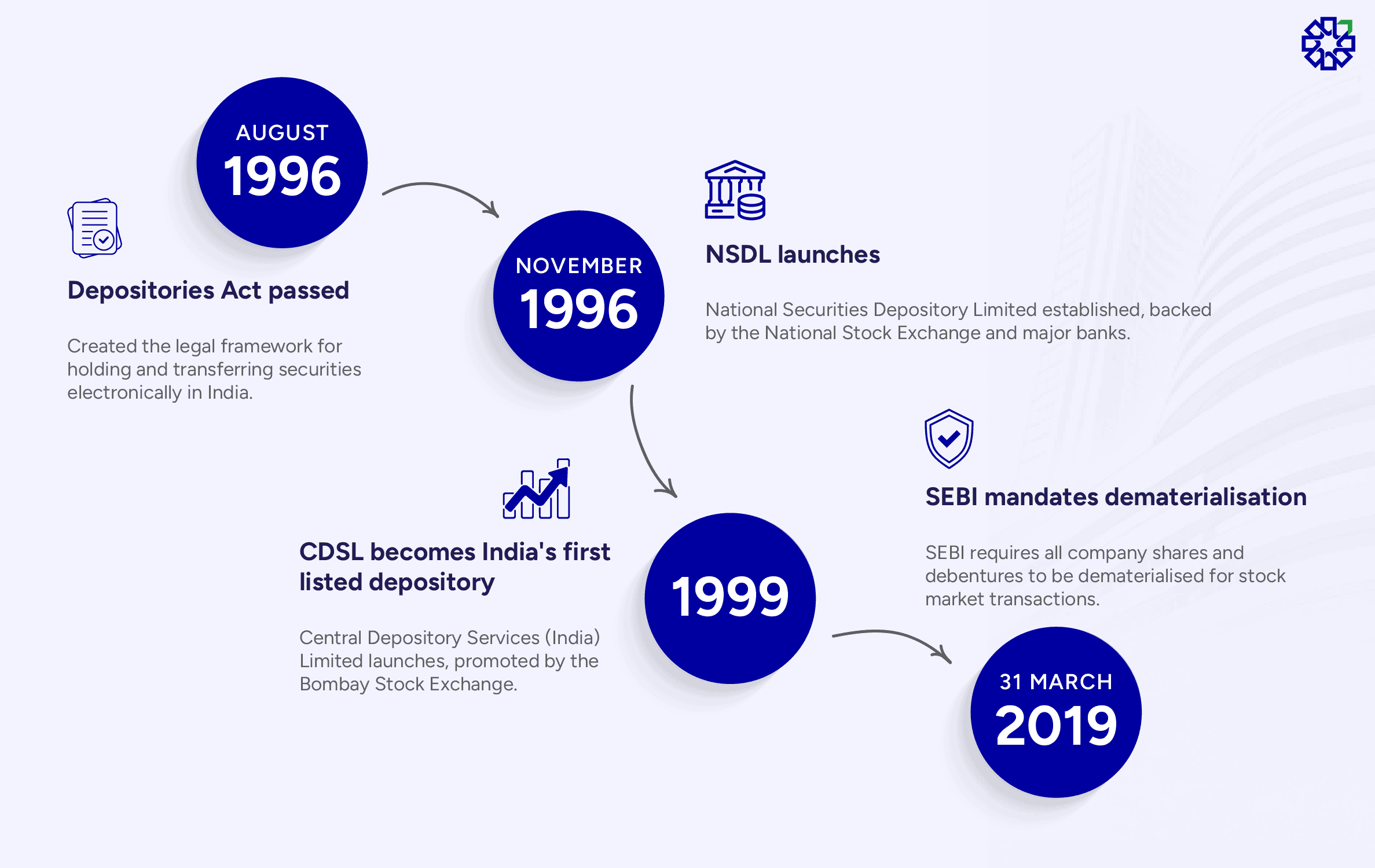
You will use a Demat account every time you trade, track your holdings, or receive dividends, bonus shares and rights issues. India has two main depositories that hold securities that is regulated by the Securities and Exchange Board of India (SEBI) under the Depositories Act of 1996.
The National Securities Depository Limited (NSDL) and Central Depository Services (India) Limited (CDSL) are the two main depositories. Investors access these services through a Depository Participant (DP). You open a Demat account through a Depository Participant such as a commercial bank, financial institution, or stockbroker, which acts like an agent.
History of Demat Accounts in India
Key features of a Demat Account
Secure Storage of your Securities
Your securities are held electronically, reducing the risks associated with holding physical certificates, such as loss, damage and forgery.
Easy Transfer of Securities
Electronic holdings like dividends, bonus shares, stock splits, interest, and refunds can be transferred seamlessly. Corporate actions like stock splits, bonuses, and rights issues are also seamlessly processed.
Convenient Portfolio Management
You can view, monitor and trade through a platform of your choice without the need to maintain physical records.
Collateral for loans
You can use your securities as collateral to get quick and hassle-free loans from reputable financial institutions. Easy access to liquidity, without the need to sell any of your investments.
A temporary pause
You can freeze your Demat account temporarily, though this is usually only available if you already hold shares in it.
Access anywhere, anytime
Since your Demat account is fully digital, you can check it from any location, on your phone, laptop or PC.
Nomination Facility
A Demat account allows you to nominate a beneficiary of your choice. This ensures that, if need be, your assets will be transferred seamlessly to the nominee.
How does a Demat account work?
A Demat account’s main function is to store securities electronically. Your trading account is where you place buy and sell orders. Your Demat account is where the securities actually stored, and where they move once a trade is settled.
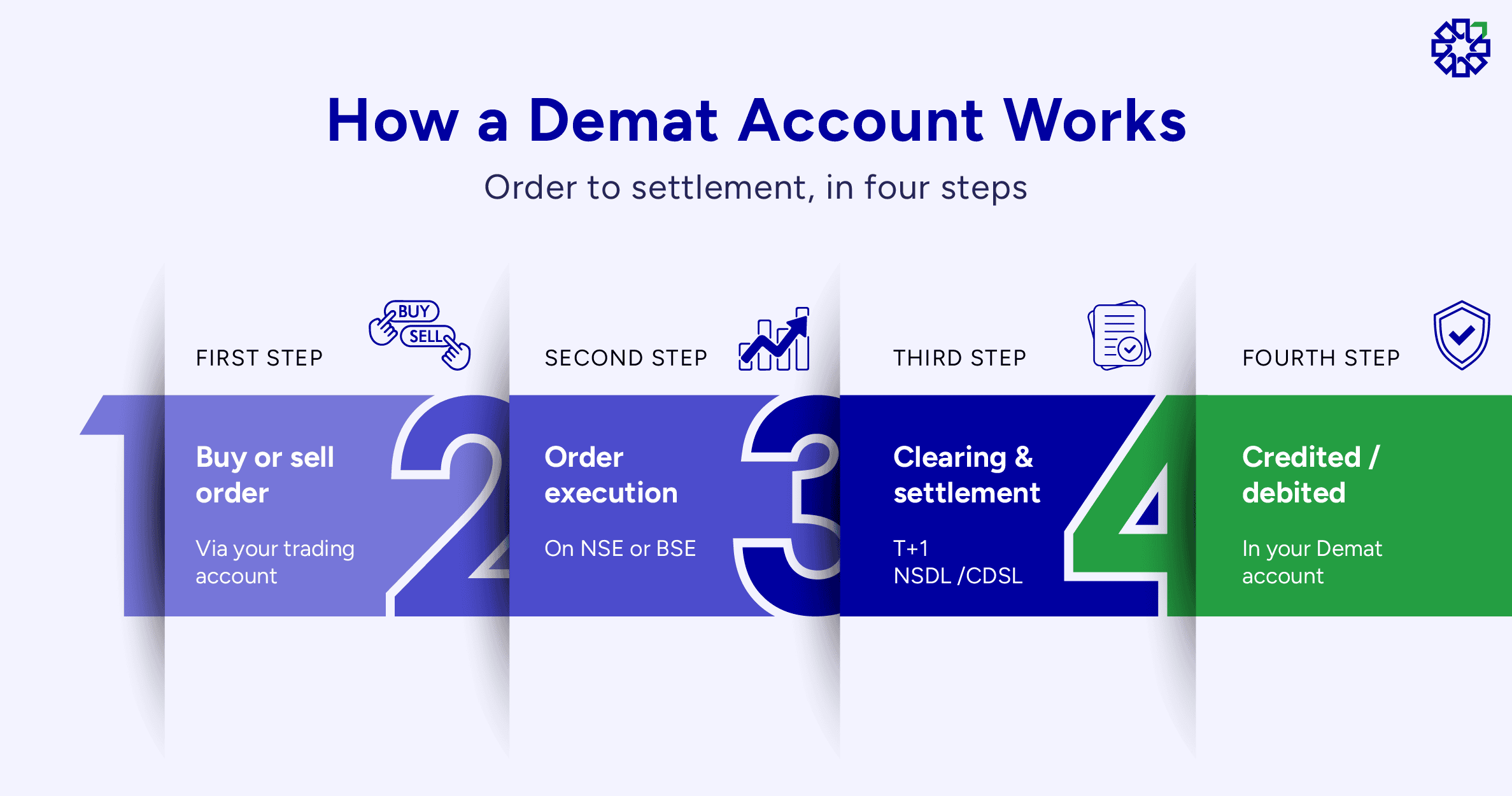
Let’s understand with a simple example:
Step 1: Place a sell order
You place an order to sell 5 shares of Company X, held in your Demat account, through your trading account using your broker’s platform.
Step 2: Order execution
The order is sent to the stock exchange (NSE/ BSE). Your sell order is executed once it matches with another investor’s buy order.
Step 3: Clearing and settlement
After the trade executes, it goes through clearing and settlement via the depository, NSDL or CDSL, completing under T+1 cycle, the next working day. Your 5 shares move out of your Demat account and into the buyer’s.
Step 4: Securities are credited or debited
Since you’re selling, the 5 shares are debited from your Demat account, and the proceeds are credited to your bank a/c. On the other side, the buyer’s Demat account gets credited with those 5 shares.
Note: The buyer and seller may hold Demat accounts with different depositories, NSDL / CDSL, through their respective DPs.
Types of Demat Accounts
Depository Participants offer different types of Demat accounts depending on the investor’s requirements.
A Regular Demat Account
A Regular Demat Account is generally used by resident Indian investors to hold and manage their securities digitally. This type of account is suitable for retail investors.
Repatriable Demat Account
A Repatriable Demat Account is available for Non-Resident Indians (NRIs) who want to invest in Indian securities and transfer funds abroad.
Non-Repatriable Demat Account
A Non-Repatriable Demat Account is also available to NRIs. Funds from such investments generally cannot be transferred abroad and the account is linked to an NRO (Non‑Resident Ordinary account).
Basic Services Demat Account (BSDA)
A Basic Services Demat Account is for investors with small portfolios. It offers zero AMC if your holdings are worth up to ₹4 lakh, and ₹100 a year if they’re between ₹4 lakh to ₹10 lakh. You can hold only one BSDA at a time, and if you cross ₹10 lakh, it automatically converts to a regular Demat account.
Documents & Eligibility
Who can open a Demat account:
- Individual retail investors aged 18 and above.
- Minors, with a PAN card, under a guardian’s supervision.
- Non-Resident Indians, through a repatriable or non-repatriable account.
- Hindu Undivided Families (HUF)
- Corporate entities, including partnership firms, LLPs, public and private limited companies, trusts and societies.
Documents required, as per SEBI guidelines:
- Identity proof: PAN card (mandatory), plus one of Voter ID, driving licence, passport, Aadhaar card, or any valid government-issued ID card. Companies need a Certificate of Incorporation, Memorandum of Association and Articles of Association instead.
- Address proof: Voter ID, driving licence, Aadhaar card, passport, ration card, a bank statement or passbook, or a utility bill.
- Income proof (To trade derivatives, F&O, commodities or currency): The last 6 months’ bank statement, current salary slips or Form 16, ITR acknowledgement, Demat holdings statement, net-worth certificate, or a cancelled cheque/passbook.
Open Demat Account Online with ease: Start Trading in Minutes | PL Capital
Demat Account Charges
When you transact in securities through a trading account, brokers incur operational costs so they may levy charges. Some offer discounts for a limited period, or free account opening and AMC (Annual Maintenance Charges), while others charge a nominal fee. Check what charges apply to maintaining and using your account before you open one.
Common Demat-related charges include:
Account Opening Charges
Stockbrokers, impose a nominal charge, and in most cases, they do impose no Demat account opening charges at all. PL Capital, also lets you open a Demat A/c with no charges.
Annual Maintenance Charges (AMC)
AMC is charged by the broker for maintaining the Demat account. However, this charge entirely depends on the type of broker. For e.g., a full-service broker usually charges an AMC of ₹300 to ₹750, plus GST. A discount broker may charge up to ₹300. In some cases, brokers waive the AMC for the first year or offer zero-maintenance Demat accounts that are free for life.
Transaction Charges
Transactions of securities that you make are subject to transaction or brokerage charges. Discount brokers maintain a flat-fee model, usually ₹10 up to ₹100 per trade. A full-service broker due to their extended services, levy a percentage-based charge, usually 0.5% to 1% on transaction values.
Dematerialisation Charges
Dematerialisation means converting your physical security certificates into digital format and storing them in your Demat account. On average, most DPs or brokers charge ₹25 to ₹150 to dematerialise your security certificates.
Rematerialisation Charges
Rematerialisation means converting your digital shares or certificates into physical certificates. Depending on the broker they usually charge between ₹10 for 100 certificates to up to ₹150 per certificate.
Custodian or Safety Charges
To keep your dematerialised shares securely stored in your Demat account, brokers charge a small extra fee for each security you hold, calculated per ISIN (each company/security has a unique ISIN code). So, if you hold shares in 10 different companies, that’s 10 ISINs, and you’d pay this charge 10 times.
Usually, it is ₹ 0.5 to ₹1 per month for each International Securities Identification Number (ISIN) related to securities.
Demat account number and DP ID
Your Demat account number is made up of two parts: your DP ID and your Client ID.
For CDSL accounts, this is a 16-digit number called the Beneficiary Owner ID (BO ID). The first 8 digits are your DP ID, identifying the Depository Participant ( Broker ) your account sits with. The last 8 digits are your Client ID, identifying you .
For example, in the number 12010000 00000001,
“12010000” is the DP ID
and “00000001” is the Client ID.
For NSDL accounts, the number is 16 characters, starting with “IN” followed by 14 digits. The first 8 characters, including “IN,” are your DP ID. The last 8 digits are your Client ID.
Usually, once you open an account with a broker, you will find your Demat account number, DP ID and Client ID on your account statement or on your broker’s platform.
Get started with your Demat Account, at PL Capital, and get access to expert market insights and investment-related services.
Frequently asked questions
-
Who can open a Demat account?
Most people can, individuals aged 18 and above, minors with a PAN card (through a guardian), NRIs, and companies are all eligible, if you complete the standard KYC process.
-
Can Demat accounts be opened jointly?
Yes, you can open a Demat account jointly with others, if everyone completes the required KYC.
-
Is a Demat account compulsory to apply for an IPO?
Yes, you’ll need one. IPO allotments are credited directly to your Demat account, so without one, you can’t receive the shares even if your application is successful.
-
Is a Demat account compulsory for investing through an SIP?
No, not always. If you invest through a route that doesn’t require Demat holdings, you don’t need one for an SIP. You can also choose to hold your mutual fund units in Demat form.
-
What is a Demat account used for?
It holds your eligible securities, shares, bonds, ETFs, electronically, and lets you manage your investments digitally instead of through physical certificates.
-
Is a Demat account free?
Opening one is often free or close to it. Some, brokers waive the account-opening fee. But maintaining it usually is not free. Most accounts carry an Annual Maintenance Charge, and some transactions will have additional charges. Check your DP’s fee structure before you open an account.
-
Is a trading account required with a Demat account?
Yes, for most transactions. Your trading account is where you place buy and sell orders, and your Demat account is where the securities are stored once a live trade is complete.
-
Can I have multiple Demat accounts?
Yes, you can open more than one, each with a different Depository Participant (Stockbrokers) Every account is maintained and tracked separately.
-
Where can I find my Demat account number and DP ID?
You’ll find both in your account statement, or under the profile or account details section of your broker’s app.